
Biogeography of urban green spaces: direct and indirect drivers of biodiversity and ecosystem services in Rome
PRIN Project (CUP: B53D2301240)
Funded by the Ministry of Education, Universities and Research
Total budget = 205,560 Euros
The last century has witnessed a massive human influx to urban areas, resulting in an extensive urban encroachment worldwide. More and more biodiversity is being embedded in an urban matrix, therefore requiring careful planning and management. Urban green spaces can host considerable amounts of biodiversity and make important contributions to biodiversity conservation, and provide several ecosystem services to citizens. It is therefore fundamental to understand the mechanisms that support biodiversity and related services in urban contexts to define good planning and management practice.
Urban ecosystems generally differ from surrounding ecosystems both in structure and composition. Factors such as patch area, isolation and shape, microclimate, and the many forms of anthropogenic factors, can all exert an ecological filter favouring species with specific traits, and increase opportunities for the establishment and expansion of alien species. The different resulting species assemblages often result in altered species relative densities due to ecological release effects, and different overall diversity. While each of these biodiversity drivers has received some attention in some taxa, their effect has been assessed mostly in isolation, therefore mostly ignoring how the effect of certain drivers is mediated through effects on other groups. Further, while drivers of ecosystem services in urban areas have been studied, little has been done on exploring the synergies and conflicts with biodiversity conservation goals.
The project UrBis aims to estimate the role of multiple drivers of urban biodiversity and ecosystem services in a more holistic framework, and assess the interlinkages between the biodiversity patterns of different taxonomic groups and their synergies and conflicts with the ecosystem services provided. It focuses on the metropolitan area of Rome, the largest city in Italy and one of the largest and greenest in Europe.
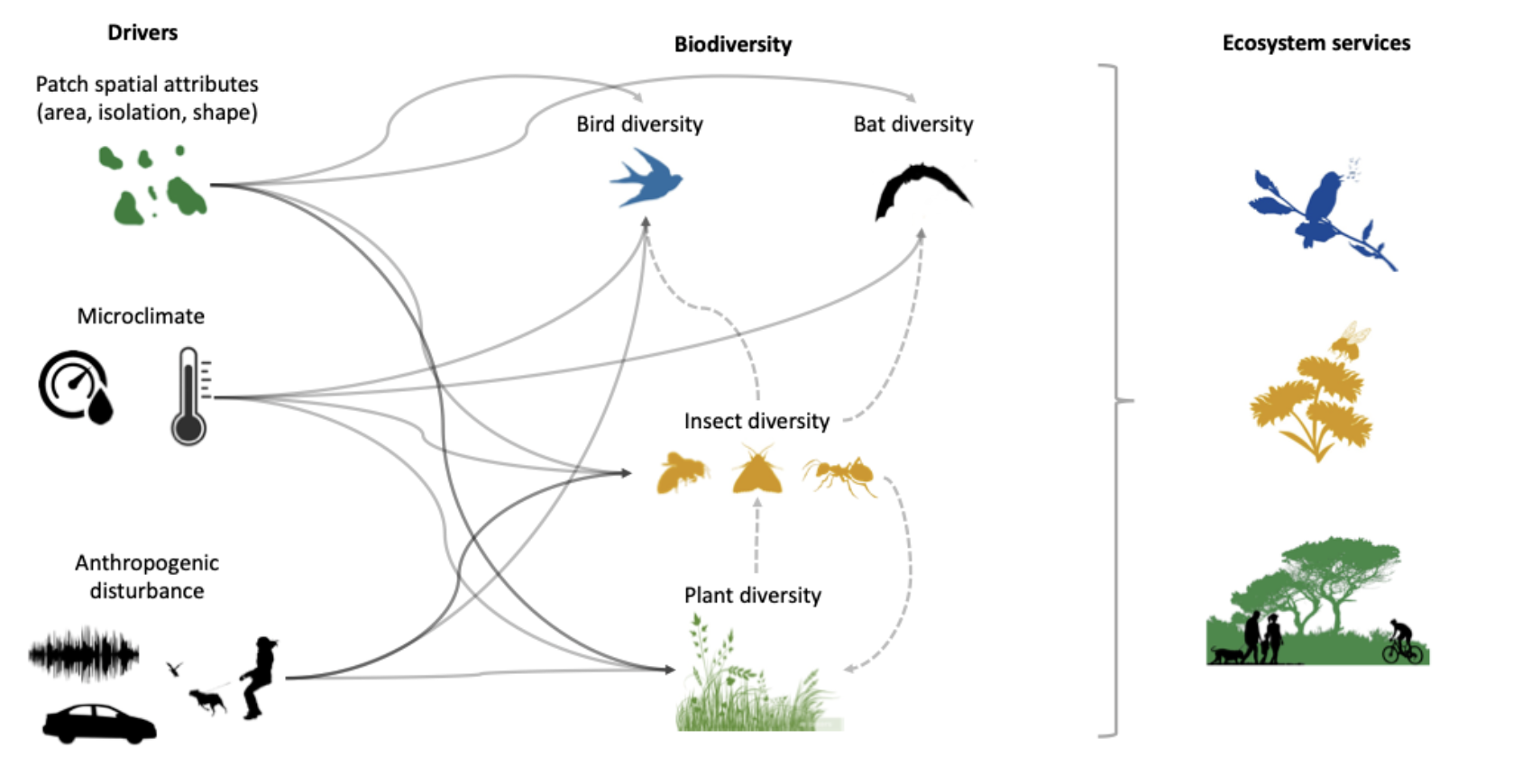
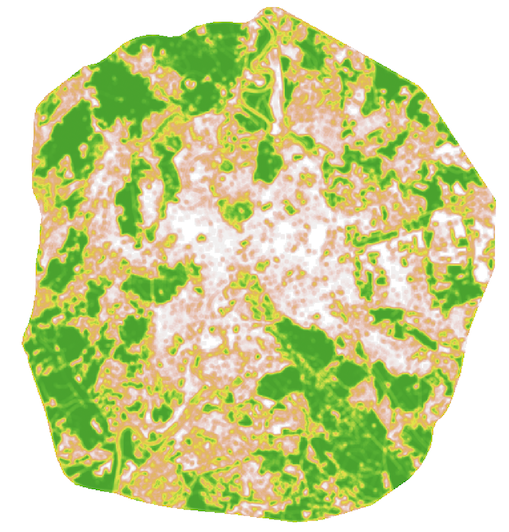
We are currently conducting an intense sampling of different taxonomic groups (herbaceous plants, insects, bats and birds) to estimate species’ relative abundance and derive species and functional diversity indices.
This project will contribute to unravelling the mechanisms supporting biodiversity and ecosystem services in urban areas, as well as shedding light on the synergies and trade-offs between biodiversity conservation and ecosystem service provisioning. The results of this project will therefore help delineate best planning and management practices for citizens’ well-being, ecosystem service provision, and biodiversity conservation.
VISIT OUR INTERACTIVE MAP
We will update the map over time as new results become available
PIs
Luca Santini (Sapienza Università of Rome) (PI)
Marta Carboni (University of Roma Tre) (co-PI)
Core research team
Andrea Di Giulio (University of Roma Tre)
Marco Andrello (National Research Council)
Collaborators
Pierfilippo Cerretti (Sapienza Università of Rome)
Leonardo Ancillotto (National Research Council)
Postdoc, PhDs and Research assistants
Greta La Bella (University of Roma Tre)
Francesca Martelli (University of Roma Tre)
Luca Francesco Russo (Sapienza Università of Rome)
Matteo Giuliani (Sapienza Università of Rome)
Daniele Saracino (Sapienza Università of Rome)
Articles
Russo L.F., Andrello M., Giuliani M., Ancillotto L., Carboni M. La Bella G., Martelli F., Santini L. 2025. Mapping the urban landscape at multiple ecological scales. Urban Forestry & Urban Greening, ACCEPTED
Mirante D., Giuliani M., Russo L.F., Saracino D., Sebastián-González E., Ancillotto L., Martelli F., La Bella G., Santini L. 2026. Bird city life: tolerance to urbanization pressure shape bird assemblage spatial patterns in a metropolitan landscape. Landscape Ecology, ACCEPTED
Giuliani M. Bird diversity… In progress….
Giuliani M. Bird density… In progress….
La Bella G. Ecosystem services… In progress….
Martelli F. Insect diversity… In progress….
Saracino D. Bat diversity… In progress….
Russo L.F. Urban connectivity… In progress….
 ecaslab.com